Ambisonics
What is ambisonics?
Ambisonics encodes a full 3D sound field using spherical harmonic decomposition (figure 1): it is a multi-channel audio encoding technique where each channel carries a given harmonic function sampled at the audio rate (see below for more details how to interpret those signals). This scene-based encoding contrasts with the usual channel-based encoding (1 channel = 1 speaker) and object-based techniques such as Dolby Atmos, where each object carries its own audio stream plus positional metadata.
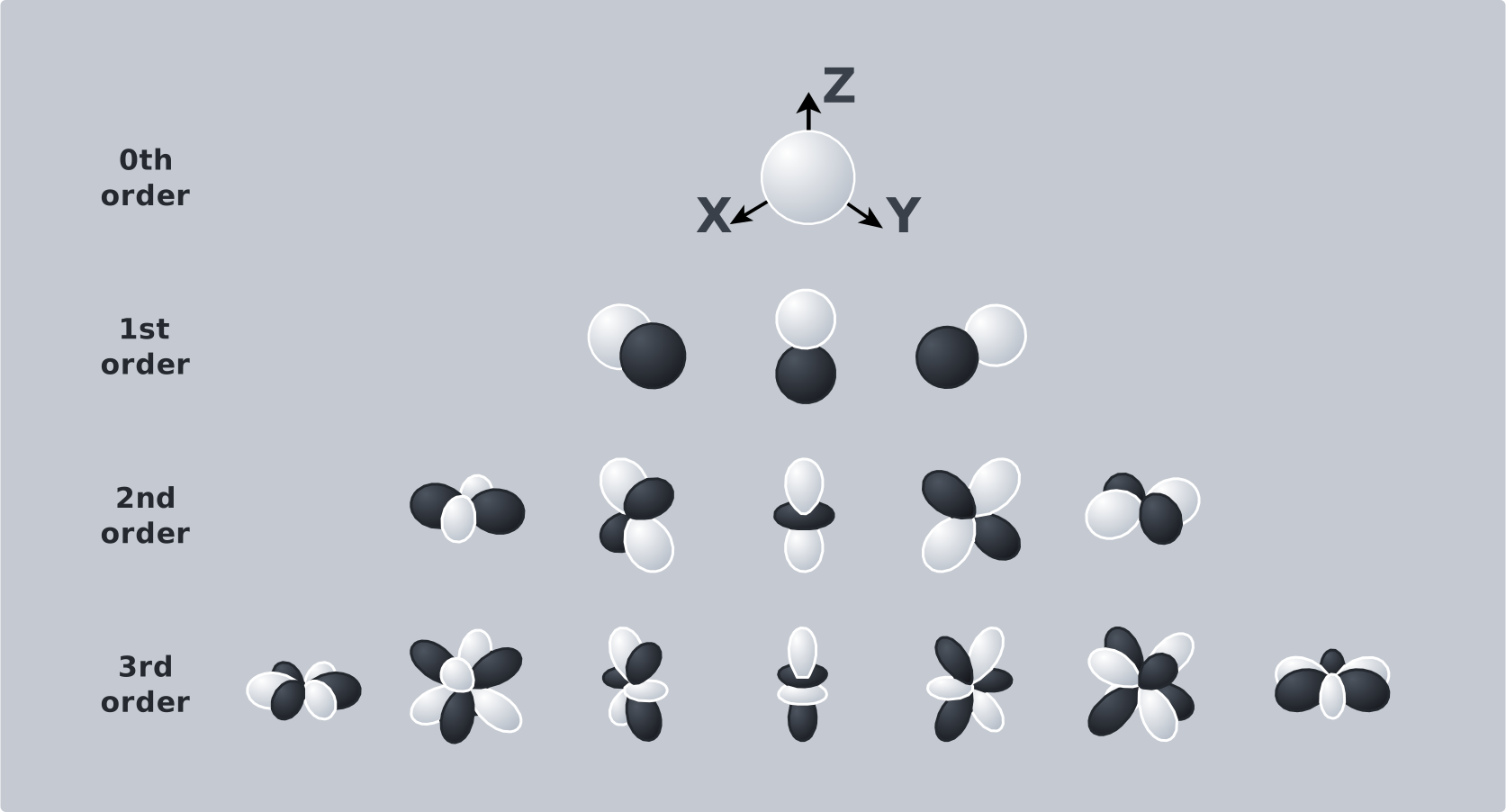
Figure 1: Spherical harmonic functions up to order 3.
Despite being less popular, ambisonics has multiple advantages that offer real opportunities for sound design and audio synthesis:
It is a relatively simple and non-proprietary technique.
It is speaker-agnostic: the same encoded signal can be decoded in many different ways, e.g., to binaural or to any speaker layout, whether standard or arbitrary.
The whole sound field can be processed in simple and efficient ways, like exact (lossless) field rotation or flipping. It is an advanced panning tool.
Applications go well beyond panning: for example, the omni vs. directional components of the sound field can be easily decoupled and processed independently.
It also has a few limitations:
It is directional / far-field only (some tricks are used to mimic the perception of distance to near sources, but those are not part of ambisonics itself).
The spherical harmonic decomposition is truncated at a given order, which sets the finite spatial resolution and sharpness of the encoded sound field. Lower orders are subject to spatial blur.
To each order N corresponds of fixed number (N+1)² of ambisonic audio channels: 1st-order = 4, 2nd order = 9, 3rd order = 16 (figure 1).
Why ambisonics in modular synthesis / VCV Rack?
The point of ambisonics in a modular context goes well beyond immersive-audio playback. Because each ambisonic channel is just an ordinary audio signal, the whole sound field becomes something that can be patched, modulated, processed and routed like anything else on the rack (note: ambisonic channels do not carry “speaker” signals, and some operations stay spatially meaningful only when they are applied consistently across the whole channel set).
There is no obligation to represent a realistic scene: the ambisonic channels can just as well carry different sound textures mapped across a sphere, turning spatial operations into a powerful sound-design tool. And why not try using it with CV signals? There’s no limitation, really.
Modular synthesis has the right workflow for exploring the full range of ambisonic possibilities. VCV Rack’s polyphonic cables make it also very convenient to carry ambisonic signals between modules (up to 3rd order = 16 channels, hopefully more in the future?).
This VCV Rack plugin aims at providing a comprehensive set of modules for typical ambisonic operations such as encoding one or more sources into a 3D sound field - or directly synthesize the sound field -, rotate, flip, decouple and process that field, and finally decode it to a mono, stereo or binaural signal or to any array of speakers. In the spirit of modular synthesis, almost anything can be controlled and CV modulated!
How to interpret the ambisonic channels?
A First-Order Ambisonic (FOA) signal has 4 channels W,X,Y,Z (the so-called B-format). The table below follows the ACN channel-ordering convention.
Channel (ACN) |
Order |
Axis |
Direction |
Plot |
|---|---|---|---|---|
0 |
0th |
(W) |
isotropic / omnidirectional |
|
1 |
1st |
Y |
left–right |
|
2 |
1st |
Z |
top–bottom |
|
3 |
1st |
X |
front–rear |
|




In idealized settings the first channel corresponds to the sound that would be picked by an omnidirectional microphone while the other three channels relate to what would be picked by figure-8 microphones oriented along the X,Y,Z axes.
The first two ACN channels W,Y are thus equivalent — up to some gain normalization — to the familiar “mid-side” representation of a stereo signal. Ambisonics may indeed be viewed as a generalization of the “mid-side” concept to 3D spatial audio!
Subsequent channels, if any, represent Higher-Order Ambisonics (HOA). They are harder to interpret, since they correspond to more complex harmonics, most of which contain information across more than one axis (figure 1).